It seems the world is experiencing such a frequency of disasters of "Biblical proportions," even the secular news sources are starting to pay attention. Case in point is this article at MSNBC:
http://www.msnbc.msn.com/id/9731623/
Thursday, October 20, 2005


Sunday, October 02, 2005
Pray for peace in Jerusalem

Pray Today for the peace of Jerusalem. Here's why:
http://www.jnewswire.com/library/article.php?articleid=778
Thursday, August 11, 2005
The One True Ref


Canada's sports website TSN reminds readers that there are only "55 days 'till the puck drops." Whoohooo!
Along with the constant news of trades and player acquisitions as managers attempt to fine tune their teams with the new budgets, comes a follow-up story to a nasty incident from the last full season:
"Former Colorado Avalanche forward Steve Moore said he was surprised when Todd Bertuzzi was reinstated to the NHL after delivering a blindside punch 17 months ago that broke his neck and left his hockey future in doubt."
Now hockey is a sport known for its roughness, so Bertuzzi's aggressive act, while hardly commendable, was not exactly a one-time occurrence in the NHL. To it's credit, the NHL used this grisly event as a platform to say "let's clean up the game."
As a matter of fact, despite the fights (both dirty and clean), the game of hockey could not be played without some semblance of order. Like any sport, the game has clear rules involving game play and conduct. Those who transgress are punished accordingly, receiving a penalty. During the penalty, the player is publicly isolated and "shamed" in the "sin-bin" for a certain length of time, which gives his teammates the temporary difficulty of being a man short.
This is not too far removed from how we treat infractions in the real world, right? Let me stretch the comparison a little more, if I may.So how is all this relevant to the goal of this blog?
- The penalty only happens if the offending player is caught/seen by the officials. Many a booing crowd are simply expressing outrage that justice has gone unpunished.
- All the players know the rules, but there is a clear spectrum of seriousness to the range of infractions. Most would agree that beating up the ref is unacceptable, but minor infractions like "icing the puck" are sometimes mere annoyances. If all players had to follow every rule 100% of the time, it would be difficult to play the game. Kind of like our society, that says, "Hey, I know the speed limit is 55, but hey, I'm late for work here. Let's 'get real'."
- Without the rules, the game would simply become a death sport. Nothing would stop players from impaling each other with sharpened sticks. I'm not saying most players would embrace such gore if it weren't actively disallowed, but who knows?
Point A - rules are not designed to kill off fun, but to protect the individual and society. Truly, God knows that the best games happen when nobody breaks the rules. Clean play results in a display of true athletic ability, which I daresay would be as much fun (if not more) to watch than mere slugfests.
Point B - the rules themselves, be they the 10 commandments, or sports rules, are logical, and easily understood by each player as necessary. In his book "Mere Christianity," C.S. Lewis suggested that everyone intuitively "knows the law." He demonstrated that, when we are caught breaking any law, we automatically defend our behavior by trying to show the extenuating circumstances that made it necessary - just this one time- to stretch the rules.
This is no different in hockey. No player who's had the whistle blown at him says: "Hey, FORGET that stupid rule. I make my own rules!" No, he has already agreed, before lacing up the skates, what the rules of the game are. Instead, the hockey player defends with: "I couldn't help it/it was an accident/I'm simply getting him back for the bad thing he did to our team that you didn't call/it's an intense game right near the end, so ease up on the rules." In other words, the validity of the rule itself is unquestioned. The only defense is to attempt to convince the referee that you didn't "really" break the law.
Some refs are more lenient than others, but no ref can completely disregard the rules of the game and keep his job. Both teams would be screaming blue murder, and demand a "fairer" judge.
Nobody respects a corrupt judge.
What would happen if a 100% play-it-by-the-book ref were to skate on the ice? A ref that demanded penalties for EVERY infraction, slight or great. A ref that had eyes everywhere, and saw every infraction. How about a ref that knows you're going to be guilty of high-sticking before the game even starts?
In real life, it wouldn't take long before the players, the coaches, the crowds in the stands, and even people watching on TV would be saying: "Who's this guy? What gives him the right to be calling every little infraction? Isn't this Joe Shmoe from Medicine Hat, the simple skate-sharpener?"
Rather quickly, Joe the ref's credibility would be questioned. Everyone would break out the NHL rule book, and line up for a chance to show Joe that he's wrong. The only problem is, nobody could do it. Joe is always right. This would just make most people even more angry, and they'd start crying for a new ref. "Get that guy off the ice," they'd yell, "We can follow the rules without Him. As a matter of fact, we've been following the rules just fine until He came along."
As Christians, we believe the extreme claims of our Joe. Joe said that He wrote the rule book. Not only that, he claims to have built all the hockey sticks, the ice, the seats in the stands, the stands, the ground the stadium sits on, and every kernel of popcorn you're munching as you watch the game Joe invented.
This, obviously, is where believers and non-believers part ways. However, rather than attempt to prove why Christians believe that Joe (the God of the Bible) DID create all those things (thus having the right to write/enforce the rules), let's just focus on ONE aspect of why people don't like Referee Joe.
The fact is, everyone playing this hockey game called life LIKES PLAYING DIRTY. Some of us are big goons, others will trip other skaters when they think no one is looking, and another group are experts at making a big deal out of a valid hip- check, diving to the ice in mock pain to get a penalty called.
I know that's a hard pill to swallow, yet that's what the Bible says. The only consolation to the fact that you are a sinner is that you are not alone.
Joe, the One True Ref, has stated the rules of the game, and expressed an intention to judge every player by those rules. Many players didn't like this plan, and decided to look for another ref, despite the fact that Joe's record was impeccable.
Many said: "O.K., I will follow the rule book perfectly." Surprise surpise, they failed miserably, DESPITE their best intentions.
Ref Joe, however, was not surprised at this failure. As a matter of fact, if you read the rule book carefully, you'll see that He KNEW the rules were impossible for this group of players. Ever since the first couple on the ice disregarded Ref Joe's first rule, the entire ice, and all subsequent players have been tainted, and INCAPABLE of playing a clean game.
This is where Christianity is often misunderstood. Dirty players don't want to admit that they like to play dirty, and even if they ARE willing to admit it, they don't want to give up the game they've been playing. But, rather than looking at their true motivation (of liking dirty play, and being unwilling to learn to play clean), it's easier to live with your "bad self" by insisting that Joe is NOT the Ultimate Ref, and His rule book doesn't apply!
This does not describe EVERY person's objection to the God of the Bible, but it IS a big one. It's understandable, if you don't have all the facts.
The Good News essentially tells us that Ref Joe knows we are incapable of playing clean. Fortunately, there is a solution offered. No, He will not overlook the penalties, but He will provide a player to take your place in the penalty box (by the way, they really do call it the sin bin).
But how, we ask, is it fair for someone to take my punishment? Well, even in hockey, it's not uncommon for one player to take the penalty for another player. Interestingly, it would not be fair for the team's poorest player to take the penalty for the team's captain. Nor would it be fair the other way around. The punishment, as it goes, must fit the crime.
OK, so now imagine Ref Joe says that He has provided one player, who will take the penalties of EVERY player who's ever played the game, for every game that ever has, or ever will be played. To be fair, would this substitute player not need to be perfect? I mean, He's taking EVERY penalty that EVER WAS, or WILL BE! Could anyone less than Wayne Gretzky take this role? Wait a minute. Ref Joe says the only player who could take all these combined penalties MUST BE PERFECT. This puts Gretzky out, because with all due respect, he had an NHL career total of 577 penalty minutes. Sorry Wayne, love ya, but you're out of the running.
Not only that, Ref Joe insists that the ultimate penalty taker (scapegoat) must have played the game, with all it's temptations and opportunities to play dirty.
But wait a minute, Ref Joe already said that no one is capable of playing clean.?
Right.
That's why no one, except God Himself, could sit in the penalty box for every player that's ever played. Yes, Jesus was a player (human), and He did play a 100% clean game EVERY TIME. Thus, God Himself, in the figure of His perfect Son, stepped in to the penalty box. This analogy breaks down here, since a trip to the penalty box in NO WAY covers the magnitude of what Jesus went through to take our punishment. If you want a better understanding of that, may I suggest watching the Passion movie. Apparently, even that was probably tame compared to the real event.
So then, if Jesus already went to the penalty box for every player's sin, does that mean we can now play dirty? Well, I suppose one could, but it would make observers wonder if you really understood the magnitude of what was done for you. The rule book has not changed - it has been made powerless since the penalties have been paid.
Jesus wants us back in the game, with full knowledge of how he has already paid every penalty. Our goal now, is to let every other player know what He has done for us. Meantime, TRYING not to deliberately sin shows gratitude and appreciation for your freedom.
Something I have to be continually reminded about is that I can't make any progress learning to play clean without focusing on Jesus. It's already been proven to me that I can't play that way on my own. Some day, in heaven, we'll all play a sinless "game," but for now, the only progress to be had seems to come as a byproduct of:Sadly, the Bible is clear that many will reject the authority, messages, and even existence of this One True Ref. Many will claim ignorance of the rule book, and the Ref, on the day He rolls the replays of their life.
- Sharing the Gospel
- Watching and studying the replays of Jesus' career (sinless life)
- Praising Jesus as the One True Ref, creator of everything, and source of all life.
Romans 1:20 states:
"For the invisible things of him from the creation of the world are clearly seen, being understood by the things that are made, even his eternal power and Godhead; so that they are without excuse."
This suggests to me that God and His rule can be seen in EVERYTHING. Even hockey. Maybe I'm just a crazy canuck making a real stretch to show the Gospel through the analogy of hockey penalties. Go ahead and blow the whistle on me for using such a loose example. I don't mind.
I encourage you, however, to read the Bible for yourself to explore your reaction. It's true that there are many rule books to this sport we call life, and just as many self-appointed refs. They can't all be right. Read all the rule books if you must. I believe the TRUTH will be evident.
Like hockey, life IS a battle. There is a spiritual battle being fought for each of our very souls. Unlike hockey, life is no game. If Jesus, as He claims in John 14:6, IS the Way, the Truth and the Life, and you reject his offer of taking your place in the penalty box, you've left the righteous Ref with no alternative but to let YOU take the punishment for your sins. If the Bible is correct, there won't be much ice near that eternal penelty box. Why not say "Thank you Jesus" today.
Enjoy the new hockey season. By the grace of the Father, in Jesus name, may you never view another game quite the same.
'Till Death Do Us Save Some Dough
 A couple of fiscally opportunistic Canadian men have decided to get hitched for the sole purposes of financial gain. Read about it here.
I wonder if they're going to consumate the "blessed" event by opening a joint bank account? Should they carry white wallets? Hmmm?
Ah, if only my fellow Canadian Wayne Gretzky (and myself) weren't already married. Sigh...
Saturday, July 30, 2005
Whatchya Polishing There?

Shortly after I came to Christ, I was introduced to the "Left Behind" series. I found the series fascinating, but did my best to focus on the entire Bible, so as not to over-focus on end-time prophecy. I know that many people feel that a lot of Christians have some kind of morbid fascination with doom and destruction, but for me, prophecy inspires me to live right today. Here's a list I've borrowed that mentions good reasons for studying prophecy:
Why Study Prophecy?
Nearly 1/3rd of the Bible deals with prophecy…events which at the time they were written had not yet occurred.
A. Prophecy Comforts and Calms (1 Th 4:16-18)
1. (1Th 4:18) “Wherefore comfort one another with these words.”
B. Prophecy Converts (Acts 4:1-4)
(fulfilled prophecy provides proof of the Bible's authority and veracity to help convert the unbeliever)
C. Prophecy Cleanses (1 Jn 3:2-3)
(we are declared righteous but we will be righteous at the marriage supper)
D. Prophecy Reveals True Doctrine
(pre-millennial position is not a popular one, but it is Biblical…literal)
(over 300 OT prophecies told of the coming Messiah...all fulfilled in Jesus, but the Nation of Israel failed to recognize Him as their Messiah)
E. Prophecy Instructs (1 Jn 2:27)
If we look at the prophecies that have been fulfilled, we see that they were fulfilled literally... and THAT fact gives us reason to believe that those prophecies that are yet unfulfilled, will be fulfilled.
That said, I also can't help paying attention to the warning of Ray Comfort, reminding us that examining the details of possible end times scenarios (amongst Christians) does nothing to evengelize. In his words:
Prophecy is great, it's fun, it sparks the intellect and proves the bible is divine revelation BUT it's polishing the brass inside the lifeboat.Good point. However, I still think prophecy itself can be a powerful evangelizing tool. If and when someone can see that the Bible is astoundingly accurate at showing what's to come, it can make the person see God's omniscience, and spark an interest in learning more about what the one true God has to say on other matters.
Once again, I hold to no specific time that the end-times will occur, but this list certainly makes one wonder if we are "in season." Today, next week, 147ooo years from now? Only God knows, but Luke 21:36 tells us to : "Watch therefore, and pray always that you may be counted worthy to escape all these things that will come to pass, and to stand before the Son of Man."
101 Last Days Prophecies
Thursday, July 28, 2005
Can Anything Good Come From Canada?

Born and raised a proud Canadian, it dismays me (as a Christian) to see the ultra-liberal path my home and native land seems to be walking down. The media that reaches me here in North Carolina would have me believe that the majority of Canadians spend their days getting high with their same-sex spouse. While one hand is busy growing and exporting marijuana to the US, the other hand is busy importing aspects of Muslim law (Shariah) in to the legal system. Supposedly, many parts of scripture cannot be uttered lest it be interpreted as "hate speech." This article by Hal Lindsay is nothing less than frightening in it's potential, long-term implications.
However, as with any country, the media coverage does not necessarily reflect what's going on in the mind and hearts of the populace. Even though he spends little time in Canada now, my fellow countryman, actor Kirk Cameron, is doing his best to spread the Good News with his "Way of the Master" Ministry. Here's a great article detailing his courageous witnessing to others on the set of the Left Behind III movie. Way to go, Kirk!
On one hand, I fully expect to see my beloved country of origin more and more in the news, as the inevitable tragic consequences of turning further and further from God come about. The good side of this is that the light that does exist in Canada will only become that much brighter. Whether or not it makes the secular news, I'm ready to hear stories of revival in pockets
of the Great White North.
How do I know this? The bible shows, over and over again, that God puts light in the midst of great darkness. The greatest darkness ever - Jesus' death - was ultimately the greatest light known to man. During earth's final days before Christ's return (the 7-year tribulation), Godless behavior will be happening at an unparalleled rate. Yet, at the same time, 144,000 Jewish witnesses will be bringing people to Jesus at unprecedented rates.
For any fellow Canucks reading this, I'd love to hear stories that verify the intense activity for Jesus when it comes.
Meantime, to Canadianize Micah 6:8, "Act justly, love mercy, and walk humbly with your God, eh!"
Sunday, June 19, 2005
Here's Mud In Your Eye

Image problem
I've always loved contrasts. Words like paradox, oxymoron, and yin/yang serve as humbling reminders of how dangerous it is to assert oneself too strongly. Throughout life, I've always been wary of forcefully insisting that I'm right, since there always seems to be too much conflicting data on any given topic. Debaters and students quickly find that, no matter what the issue is, there are stacks of research of equal height to "verify" both sides. I like to think that my gentle nature is simply a reflection of this fact, but I'm sure there are those who would argue that I'm simply wishy-washy.
To be sure, the only thing I'm 100% convinced of is God and His Word. May God never let that be shaken.
My reading today offered a rather intense contrast. The FIRST thing I read today was an article on the front page of my local newspaper. It describes some fake mud that SUV drivers can spray on their vehicles to give the appearance of actually using your RV for off-road activity. The brisk sales of this product suggests that many are loathe to be perceived as driving such gas guzzlers simply because they can. This, folks, is front page news.
The LAST thing I read today was an online article on Christian suffering titled "It's Hard To Be Like Jesus." I'm going to print it out, and carry it around with me so I can pull it out any time I feel like life's not treating me fairly.
It was easy to read the first article, and feel superior to the crowd that would shell out money to gaurd their image. Can you imagine catching someone in the act of spraying this stuff on their SUV? I can almost hear their defense:
"Well, I really AM a rugged kind of guy, and I really do PLAN on doing some off-roading. But you know, with the business of life and all, I just haven't had a chance to actually GET to it yet. Hey, I'm just putting across the image of who I really am INSIDE - the guy I'm BECOMING, you know?"
Let's give our sprayer credit where it's due. Maybe he does have SOME rugged qualities. Given time and practice, perhap he WILL grow in to the daring off-roading "stud of the mud" he envisions. Some day. Today however, we know how far he is from that ideal.
I could only hope I would be granted such understanding from a suffering missionary who would examine my comfy Christian walk. I can almost hear my defense:
"Well, I really AM willing to pick up my cross daily, and I really do PLAN on doing some serious missionary work. But you know, with the business of earthly life and all, I just haven't had a chance to actually GET to it yet. By calling myself a committed Christian, I'm just putting across the image of who I really am INSIDE - the guy I'm BECOMING, you know?"
Luckily, a true man of God would probably not condemn me as a faker, because he would know that our maker will not cease His work of changing us until we are like Christ. Meantime, I'm reminded of how far I am from that ideal.
Meantime, I believe God has reminded me why it's not for me to judge the SUV sprayers of the world. He knows that ALL of His followers have spray cans of various sizes. Dare I imagine what Jesus would say to us, I think it would be something like: "Just keep following me in Faith, and I'll loosen your grip on that spray can until there's no need for it."
Thank you Jesus, for your awesome patience.
Tuesday, June 14, 2005

Friday, June 10, 2005
Pimple on the Body of Christ?

Ole Anthony
Oh man, if you want a good read, this is it. This guy (Ole Anthony) is dubbed "the man televangelists hate." I haven't read anything this inspiring, laugh-out-loud-funny, yet bordering on irreverent, in.. well, I don't know when. And that's just an ARTICLE on the man and his ministry. I can only imagine how fascinating he would be in person. If you like 'em rough around the edges, start reading, and enjoy...
Tuesday, June 07, 2005
7's on the Seventh

7
I'm busy preparing for an exam on Thursday, so I haven't posted much. Meantime, since today is the 7th, here's a fascinating article on the number 7:
Shavuot and the Magnificent 7's
In the beginning... God created 7's. Oh sure, He created light and dark, the heavens and earth, too. But for reasons unknown to us, He seemed to have a special affinity for the number 7. The fact that the Torah begins with a verse containing 7 words and 28 letters (divisible by 7) is hardly remarkable. But when placed within the context of the overwhelming number of associations in Judaism with '7', a fascinating tapestry begins to unfurl. Let's take a closer look at this phenomenon. WHY "SHAVUOT?" Every spring, Jews around the world celebrate the holiday of Shavuot --commemorating the most seminal event in the history of mankind, God's revelation at Mount Sinai. Shavuot. Curious name for this holiday, no? Shavuot means "weeks," underscoring the 7-week period between Passover and Shavuot in which we count each day (and week) in anticipation and preparation for re-living the Sinai revelation. But why call it Shavuot -- "weeks"? Why not call the holiday "Torah," or "Sinai," or "Commandments," or "Tablets." Of what significance is "Weeks"? Time contains many different entities. Nearly all of them are related to natural phenomena. Days, nights, months, seasons and years are all directly determined, in some way, by the constellations. There is one exception -- the week. The formulation of a week seems to be totally arbitrary. Who needs it? Let one day just follow the previous one. And why 7 days? The concept of a week and its constitution of 7 days is one that is strictly God-invented and human-adopted. While we may quibble about creation -- how, when, by whom, why -- the world has consensually agreed to the concept of a week. The Beatles were wrong... there are only 7 days in a week. And whenever a week is completed it is yet another reminder to mankind (or should be) that God created the world in 7 days. (Only 6 days were required to manufacture the physical structures, but the process was not complete until the spiritual realm, Shabbat, was added.) Call it the "week link." WHY "7"? Kabbalah teaches that 7 represents wholeness and completion. After 7 days, the world was complete. There are 6 directions in our world: north, south, east, west, up and down. Add to that the place where you are, and you have a total of 7 points of reference. Shavuot, marking the emergence of the Jewish people into a nation, by virtue of their receiving and accepting the Torah, also marks a completion. Perhaps that is why the holiday is called Shavuot, "Weeks." We want to identify this holiday as a completion of the process of Jewish nationhood. No one is certain why God chose the number "7" to signify completion. All we can do is speculate, observe and marvel. In honor of our own completion of the 49 day period leading up to Shavuot, we present 49 allusions to the number "7" within Judaism. How many of these do you recognize? How many more can you add? THE MAGNIFICENT SEVENS!
This article can also be read at: http://www.aish.com/literacy/mitzvahs/Shavuot__and_the_Magnificent_7s.asp
Friday, June 03, 2005
Late to the Party I Am
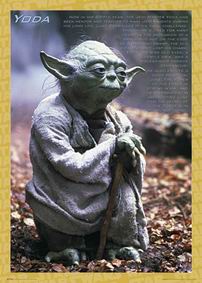
Yoda
O.K., it's already two weeks since the latest Star Wars came out. Many blogs I follow had observations on this event the day after it was released. Surely, Yoda would admonish me thusly: "Late to the party, are you." Hopefully, you'll forgive me for covering something that's two weeks in the distant past. If not, you may have real difficulty when I tie in events from over 2005 years ago....
I went to the movie with my 10 year-old son. I'm one of the many fathers who got to introduce this younger generation to the Star Wars saga when the series resumed with The Phantom Menace. The big difference for me, as a viewer, was that I now see with a brand new set of eyes. So, viewing Revenge of the Sith opened up a whole new dimension of spiritual connotations that I didn't focus on too much while enjoying the first 5 Star Wars movies.
Of course, Star Wars is just a fantasy movie, so perhaps an examination of it's spiritual components is not called for. I did, in fact, remind myself to just enjoy the film - especially since it was quality time with my son. I deliberately forced myself to "watch and enjoy now - analyse later." Even still, driving home from the movie, I couldn't help but offer a couple observations from the Christian perspective to my son. Thank God, it actually turned out to be a good (if brief) conversation.
So why should I bring this issue in to this blog? Yes, it is just a movie. BUT...an article by John Sweeney titled Jedi “Religion” Sees Dramatic Growth (we’re not kidding) reports that an increasing number of folks see Star Wars as much more than just a fantasy film.
At risk of posting yet another long post, I'd like to offer some comparisons/contrast between the Jedi "religion," and the way of the one true God of Christianity. First, the similarities:
- Both have a "dark lord" who uses lies to entice people to evil. Interestingly, both involve lies concerning death. In Christianity, it was Satan who suggested to Eve that, contrary to what God had told her, she would NOT SURELY die if she ate the forbidden fruit. In Star Wars, Palpatine suggests to Anakin that the dark side has knowledge of how to cheat death. Palpatine himself, admits that this power is not "natural.' In both cases, the dark power is hinting that those following the light side have been duped, and should come out of their naive, archaic beliefs to a mature, practical acceptance of harsh reality.
- In both, the stated agenda of the dark side is peace. In Star Wars, Palpatine claims that his ultimate goal in wiping out the Jedi is simply to stop all the fighting, and bring peace to the galaxy. In the Bible, we learn that the anti-christ will come on the scene bringing a similar lie of peace.
- In both, the members of the dark side come to see the members of the light side as the enemy. In Star Wars, Jedi's are seen by the dark side as a threat to be hunted down and killed, lest they continue to bring imbalance to the galaxy. In the Bible, the Lord Jesus spoke of a future time when He said that those who kill us (referring to Christians and/or Jews) will think they're doing God a favor (John 16:2). Indeed, in many parts of the world, this is happening now (see THIS or THIS site). Edit as of 6/7/05, I just stumbled across this new blog about Christian Persecution: http://www.persecutionblog.com/
- In both, followers of the light side are expected to give up selfishness, and pursue the common good.
- In Star Wars, the qualities and characteristics of the light and dark sides are vaque and nebulous. Of course, this is a film, so Lucas is hardly to be blamed for not spelling out the foundations of "The Force." In contrast, Christianity (through the Bible) offers a full description of good/evil, instructions on exactly how to live, and the characteristics God himself!
- In Star Wars, one seems to have to move away from good by voluntarily choosing to align with the dark side. The Bible, however, teaches us that we are all born sinners, and must come to the light by accepting Jesus' sacrifice for our sins.
- Star Wars never suggests that the "force" will ultimately exert itself, bringing divine justice throughout the galaxy. Thus, it is up to the Jedi to bring about, and maintain, ultimate good. They do this with the sheer force of ninja fighting techniques and light sabres. In contrast, Christians know that Jesus will return to bring justice, and set up the eternal abodes of the righteous (Heaven) and the unrighteous (Hell). Rather than a sword of laser power, Christ's sword will emanate from his mouth. His sword will be His Word, and with it, He will be victorious. This is not to say that followers of Christ are not expected to live as righteously as possible BEFORE Christ's return, but we know that we are powerless to bring peace by our own efforts. Christ will return as our King. EVERY knee will bow to Him, the creator of all things.
- Star Wars, as fun as it is to watch, is the product of a human being's imagination. In contrast, everything that actually exists is the real product of a real God. George Lucas needed countless helpers and complex technology to create a 12-hour world that only exists as a fun diversion for the eyes and ears. In contrast, God used Himself alone to THINK everything in to existence, including one of his more creative products - George Lucas.
Sunday, May 29, 2005
Satan on Ice

Devil against drugs
If you click this picture you'll se that Satan is working for the drug-prevention organization called D.A.R.E. . Who knew the prince of darkness was so against drugs? This is not as surprising as it might sound. As a substance abuse counselor, I'm aware of statistics that show D.A.R.E., as well intentioned as it might be, seems to do nothing more than pique kids' interest in drugs. Ah, the road to Hell IS paved with good intentions.
Satan posing as a benevolent advisor is hardly new. Reminds me of one of my all time favorite movie lines: In "The Usual Suspects," the narrator says that "Satan's greatest trick is making people believe he doesn't exist."
As a hockey fan, I've always been kind of bummed out at the New Jersey Devil's choice of team name. O.K, I know it's just a name, but apparently, my concern is shared by NJ State Assemblyman Craig Stanley. Here's the article discussing the whole debate.
Thursday, May 26, 2005
God's Gray Matter/s
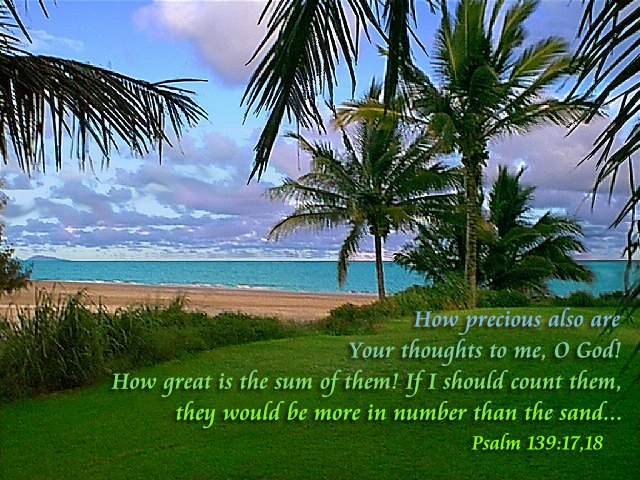
psalm 139
Before I started reading the Bible, I had real difficulty imagining a God that payed much attention to me. After all, with, what, almost 6.5 BILLION people on the planet, He's going to have time to consider little old me? I suspected that, if anything, God might have some magical hard-drive of all my activities to consult on the rare occassions He wanted to check up on me.
I suspect my difficulty involved my inability to conceive of any thought power beyond my own abilities. For me, trying to remember the birthdays of my own loved ones was a challenge.
The beginnings of my newfound appreciation for the omniscience of God involved a chess match I was slaughtered at. Not only was I quickly and decisively trounced by my opponent, the guy whipped me while doling out the same punishment to about 40 simultaneous victims. He was a chess whiz, making money by plying his trade at shopping malls across the nation. He would set up 40 chess boards in a large rectangle of tables. Opponents could seat themselves as they pleased, and the wizard would walk around the inside of the tables, playing each game to it's conclusion, one move at a time. "Round and 'round the chessmaster goes, how he keeps winning, nobody knows" would have been a fitting slogan.
Even though getting beaten by this guy was humbling, it did teach me that some beings can handle much more data than I can.
Now I enjoy the game of chess, but I've quickly learned that my talent does not match my enthusiasm. Here was a guy that was so many LEAGUES beyond me, we probably don't even see the chessboard the same way. And yet, this chessmaster was making a living doing glorified parlor tricks. How about the mind of a Bobby Fisher, or Kasparov, or even Deep Blue, the IBM computer that took on the world's best humans? How many separate games could those brains juggle at once? Impressed yet?
How about the One that created the minds (and every other part, for that matter) of the Bobby Fishers of the world? What kind of power has created every genious that has ever lived? Oh, and let's not forget to add that this same God created innumerable other living creatures, plants, rock formations, forests, plains, oceans, planets, stars, galaxies, and everything in them. Impressed yet?
How about the God that makes all these things work together in harmony? The God that devised food chains, hierarchies, and inter-locking systems that could not work independently? The God that uses each of his creations for multiple functions. Stunned yet?
Once I believe that One God created all, it's really no problem seeing that this God has enough mental resources to observe each human being simultaneously. I no longer need to think that God has to "catch up" with my activities when he wants to consider me. He has known my every move before I started making it.
My pastor's most recent sermon expounded on something that makes all this even richer. Not only CAN God keep track of me if He wants to, He DOES WANT TO. God doesn't merely reserve Thursday night's at 7:53 for His "what's Tom up to this week?" time. He thinks about me (and YOU) CONSTANTLY! Thanks to my pastor for this message. My concept of God and his mental power is forever expanded.
The icing on this whole cake? God's thoughts are not of the "Wow, is Tom ever messing up this week" variety. God is not shaking His head in constant sadness, muttering to himself: "Why did I ever save this guy?" He is lovingly planning the next step for my advancement in Christ-like thought.
But hey, don't take my word for it. As much as I trust my pastors, don't even take their word for it. Take the Word's word for it. Go to Psalm 139, and read for yourself:
Psalm 139
O LORD, you have searched me and you know
me.
You know when I sit and when I rise;
you perceive my thoughts from afar.
You discern my going out and my lying down;
you are familiar with all my ways.
Before a word is on my tongue
you know it completely, O LORD...........
Sunday, May 22, 2005
Crazy Paul, et al
 It's well-known by those in the mental health field that many of the "delusions, compulsions, and obsessions" experienced by people with schizophrenia (and other mental health "diagnoses") have a spiritual flavor to them. I'm a strict substance abuse counselor now (if there is any such thing), but in my former years as a mental health worker, I've seen fights nearly break out between clients over which one of them was the "real" Jesus.
On a more positive note, I've often heard PROFOUND spiritual things uttered by those whom society would label as "needing stronger meds." In these situations, I'm silently humbled by the "truths" coming out of the person I'm supposedly there to help. One is left mumbling under one's clinical breath: "One of us is being shown a lesson here today, and by God, it's not me."
The question of "are some flavors of mental disturbance a case of being more attuned to something spiritual?" is a far bigger topic than I can do justice to in a short post. However, THIS article by John Piper is a great reminder that God has/can/ and probably will, use "colourful" folk (I don't mean skin colour) in his plans. The article is about a guy who single-handedly wrote one of the first Bible concordances, but demonstrated some pretty bizarre behavior all the meanwhile.
In the book of Acts 26:24-29, the apostle Paul was on trial for his beliefs in Christ, and was accused of being crazy. Festus thought Paul had had his head buried in the Old Testament for too long, and was getting some kind of academic burnout:
24 Suddenly, Festus shouted, "Paul, you are insane. Too much study has made you
crazy!"
25 But Paul replied, "I am not insane, Most Excellent Festus. I am
speaking the sober truth. 26 And King Agrippa knows about these things. I speak
frankly, for I am sure these events are all familiar to him, for they were not
done in a corner! 27 King Agrippa, do you believe the prophets? I know you do -
" 28 Agrippa interrupted him. "Do you think you can make me a Christian so
quickly?"
29 Paul replied, "Whether quickly or not, I pray to God that both
you and everyone here in this audience might become the same as I am, except for
these chains."
Regardless of your current state of mental health, may you too come to an "insane" understanding and love of the Gospel! Oh, and enjoy the article ...
Tuesday, May 17, 2005
Onion God
 God is reading this. Maybe that sounds cocky, but I don't mean it that way. Let me tell you how I know.
A few posts back, I wrote about how God seems to iron out the imperfections in our musical worship team. The point of my post was about remembering the reason we are worshipping (not about OUR glory), and leaning on God to help us overcome our human imperfections in worship.
The VERY next worship team I attended after posting that article was very difficult for me. I couldn't seem to get ANYTHING right. It was as if God was saying: "So, Tom, you think you've got a grasp of how I work, do you? You've understood this aspect of me enough to post it on your blog, huh? Well guess what Tom, you haven't BEGUN to see how deep this issue can go. But since you're atuned to the topic, let me give you the opportunity to practice what you preach!"
When I shared this with the other members of the worship team, they informed me that God OFTEN works that way in their lives. That is, just when you think you've mastered something, and got it all figured out, our Maker leaps in to notch the whole struggle up, and lovingly remind us how far we've got to go in our spiritual development.
I was excited to learn from my fellow Christians (all of whom have been walking in Faith for longer than I have), that this experience is common. Here was a new revelation of how God works!
Of course, I could take this revelation, and foolishly think I'm getting close to figuring out God and his ways. How many times have I been reminded not to "put God in a box?"
No, if I've learned anything of our God's methods, it's that HE seems to abhore predictability. Sometimes I think (and I know I'm not alone in this thought) that God will deliberately move in the exact opposite way of how any human would do it - just to remind us of the immense gulf between His way... and our ways - between the Creator... and the creation.
As for me, I feel that God doubly blessed me. Not only did He pull me further in to learning to lean on him, he gave me a new clue as to how to listen to Him. Of course, He may use a completely different method tomorrow, but right now, I THINK I've learned to be on the lookout for what happens right after I think I understand something. When I think I've peeled off the last layer on the onion of understanding, He is ready to show me the deeper layers.
I'll tell you one thing, I'm going to be careful of what I decide to post on this blog! I might think I've got something to share, but the heavenly reader might be more concerned with the guy at the keyboard. Or maybe, He will touch a reader and the writer simultaneously. Tell me, fellow Christians, does God ever work on more than one level at once? Maybe the better question is: Does he ever not?
Saturday, May 14, 2005
What, No Explosions?

This is a long read, but highly worth it. It's not my writing. If you are not accustomed to reading much, and prefer to be blown away by an intense action movie, slammin' concert, nail-biting sports event, or reality TV that "pushes the envelope," this will be a snooze-fest. Unfortunately, you're the kind of person who NEEDS to read it the most.
I'm not saying I don't enjoy the pleasures listed in this article, but it's a matter of degree. If I've made any progress in this regard, it's the fact that I would rather read this article now, rather than automatically wait for the big-screen HD version, complete with car chases, explosions galore, and a femme fatal. It's Saturday night as I write this. It's tempting to put on a movie now that the kids are asleep. Instead, I think I'll mediate on Psalm 46:10"Be still, and know that I am God"
Here's the article, or, if you'd prefer to read it on it's own page:
Still Bored in a Culture of Entertainment
By Dr. Richard Winter
Rediscovering Passion and Wonder
Let your imagination wander for a moment. You have an evening free: nothing to do, no responsibilities for other people. I wonder what your first thought is. A movie? A video or two? Imagine what it would be like to have none of the movies, TV programs, sporting events, web sites, theme parks, or radio shows that are available to modern people in developed countries.
We find it hard to conceive of such an existence; in fact, some would find it frightening. What would we do with ourselves? How would we survive the famine of entertainment? I suppose a major power failure could give us a taste of what it would be like. What did previous generations do with themselves?
In one weekend, my city of St. Louis can offer baseball and football excitement (at the right time of year), multiple concerts, movies in cinemas and on video, plays and art exhibits, and a plethora of TV channels to watch at home. How could anyone be bored in this culture of entertainment? It seems almost impossible. And yet, paradoxically, a recent annual study of the opinions of consumers revealed a boredom boom. This survey found that most people desired more novelty in their lives.
The Disease of Our Time
We are bored, despite living in remarkable times. Just as a drug user develops a tolerance and needs larger doses to achieve the same effect, so we too have developed a tolerance to amazing events and, perhaps, to entertainment. Reader’s Digest highlighted this in an article called “How to cope with boredom.” It says, “Despite its extraordinary variety of diversions and resources, its frenzy for spectacles, and its feverish pursuit of entertainment, America is bored. The abundance of efforts made in the United States to counter boredom have defeated themselves and boredom has become the disease of our time.”
This is not only true for the United States. In Britain, a recent article in a major national newspaper reported the Archbishop of Canterbury saying, “We are a deeply and dangerously bored society and we are reluctant to look for the root of that. What has happened to us?” He asks, “Why are we so bored?”
More Leisure Time
Since the mid-1800s, for many people both lifespan and leisure time have increased enormously. People in the mid-1800s worked seventy hours a week and lived forty years. Now in developed countries people can work forty hours a week and live seventy years or more. One author calculates that this gives the average person about 33,000 more leisure hours than a person might have had in the mid-1800s.
Not only that, but the type of leisure activities that people engage in today has changed. Much time is spent alone in front of electronic entertainment. Previously the time would often be spent with family: making music, telling stories, and socializing with friends and the local community. In conjunction with this, “alone time” has also risen as people have moved out of smaller rural communities to the industrialized cities, where anonymity is easily achieved.
Now, when we come home, rarely do we get together to make music or play games. We do not need our neighbors anymore. No longer do we sit out on the porch (air conditioning has contributed to that, too) and talk to neighbors. We go inside, shut the door, and go to our private entertainment places.
Entertained to Excess
Boredom is easily recognized when there is nothing to do. But what about this idea that too much entertainment gives rise to boredom? Not only do we have entertainment and information thrown at us all the time in our homes, but also something is trying to keep us entertained almost everywhere we go. Long lines at amusement parks now come with overhead TVs to help pass the time. Airlines show movies. Cars include radios, CD players, and now DVD players. And when I stopped at one gas station, I was amazed to find a small video screen at each pump, just to make sure that I would not get bored for the few minutes it took to refuel!
When stimulation comes from every side, we reach a point of being unable to react with much depth to anything anymore. The boredom we feel today is probably as likely, perhaps more likely, to come from overload than underload.
Over-stimulation is felt most in relation to entertainment and advertising industries. Instead of making our own entertainment, we rely on radio, TV, movies, video games, surfing the web, and so on. Now I am not saying these things are intrinsically bad. The problem comes when we come to depend on them too much. Today, it is no longer necessary to put work into being entertained. A person can be a “couch potato” and let it all happen. Neil Gablar’s book Life: The Movie, How Entertainment Conquered Reality shows how today everything has to be exciting to grab our attention. Entertainment becomes the primary measure of value. The media create expectations for us so that ordinary life becomes increasingly boring and we grow more dissatisfied. Like drug addicts, we want a bigger fix next time.
Additionally, to the contemporary mind, goodness and beauty often seem boring and unstimulating. They do not give the same adrenaline or testosterone rush that violence and sex do. Abnormal behavior is put on display to engage us, as in TV programs like the Jerry Springer show.
And thinking of extremes, there is a huge and growing interest in extreme sports. In Outside Magazine, one professional skydiver and skysurfer is quoted as saying, “It’s only when my body is screaming towards earth that I feel most truly alive."
Those of us who do not hunger for such extreme stimulation can still find plenty of entertainment in the endless shopping malls, restaurants, fitness clubs, bookstores, tennis clubs, golf courses, concerts, movies theaters, and late night Letterman and Leno.
Now, what does all this do to us? I would suggest to you that being surrounded by and taking in all this entertainment stunts our imaginations and our creative capacities. And it shrivels our own inner resources to make and find entertainment. It is much like not using our muscles anymore; eventually we do not know how to use the muscles of the imagination. As the inner resources shrivel up, we need more and more stimulation from the outside, a bigger and bigger fix, to get the same entertainment and sense of stimulation.
Advertised to Apathy
Not only is our society bombarded with countless entertainment options, we are also met daily by messages from the advertising industry that are designed to make us dissatisfied and bored with what we have and who we are. Perhaps some in our society have become so chronically disappointed by false advertising promises that they have shut down their deepest longings and desires and become apathetic and bored.
Fragmentation of Faith
Patricia Spacks, reflecting on the apparent increase in boredom in the last three hundred years, believes that one of the possible reasons is the decline of orthodox Christianity. Spacks, who does not evidence any particular Christian outlook in the book, says, “The history of commentary on boredom shows a steady decline in faith.” The suggestion is that as Christian faith declines, boredom increases. In the past, the Christian view of life gave a motive to endure struggle and difficulty and boredom in life. Contentment was preached as an important virtue. People felt responsible to work hard, to take an interest in and get involved with life, especially with their family and wider social responsibilities. So boredom was seen either as a sin, or as a sign of moral weakness or character failure.
If there is no God out there to give you a sense of purpose and direction in life, how are you to find meaning and happiness? Spacks suggests that boredom is a metaphor for the postmodern condition. Behind the bright lights, optimism, and busyness of our culture lurks haunting questions that many want to ignore. The heavy topics of “what’s the purpose of life?” and “why am I here on this planet” tend to be conversation killers in most situations. Sports, sex, relationships, work, the latest soap opera, television show or movie are much more acceptable.
In the Bible, the writer of the book of Ecclesiastes describes how he tried to find satisfaction in every possible form of activity: work, wealth, pleasure, gardens, and (many) beautiful women. And instead he ended up with a sense of emptiness that is a lot like the description of boredom: “I denied myself nothing my eyes desired. I refused my heart no pleasure. My heart took delight in all my work and this was the reward for my labor. Yet when I had surveyed all that my hands had done and what I had toiled to achieve, everything was meaningless, a chasing after the wind. Nothing was gained under the sun.” (Eccl. 2:10,11)
Counteracting Boredom
Obviously some things in life are boring. In a fallen world, some tasks are inherently tedious and dull, but how we approach them is crucial. Boredom can be a healthy stimulus to action and a challenge to use our creativity. And to face the most monotonous parts of life we must remember the big picture that gives meaning to the little things. When I am repairing the lawnmower for the sixth time and mowing the grass for the sixteenth time that season, I have to remember that this all contributes to creating a place of beauty in my garden, a place that people can enjoy. Part of what God has set us in the world to do is to create lovely places where we can relax with others and enjoy true leisure. It is important to think of the big picture when washing the dishes and to ask where this fits in with the whole of life and marriage and having families and so on.
We need to grow in delighting in the simple and the ordinary—to, as we say, stop and smell the roses. This is where the busyness and dependence on constant entertainment prevents us from cultivating true wonder at the ordinary things of life. Mary Pipher writes, “Most real life is rather quiet and routine. Most pleasures are small pleasures: a hot shower, a sunset, a bowl of good soup, a good book. Television suggests that life is high drama, love and sex . . . .Activities such as housework, fundraising, and teaching children to read are vastly underreported. Instead of ennobling our ordinary experiences, television suggests that they are not of sufficient interest to document.”
Is God sitting back and feeling bored with his creation? From all that we read in the Scriptures, He feels deeply and passionately about all that He has made. There is a rhythm and order to the creation, a repetition of grand themes in the cycles of nature. The Bible tells us of a God who enjoys beauty and glory in what He has made, and wants us to do that too. And yet He is a God, also, who grieves over the ugliness of sin and the brokenness in His creation. He wants us to develop our gifts, but He also wants us to work hard, redemptively, against the evil and the brokenness of our culture and our world. We are to reflect the image of God and how He has made us, both in how we enjoy His creation, but also in how we fight against evil.
It was Edmond Burke who said, many years ago, “The only thing necessary for the triumph of evil is for good men to do nothing.” Resignation, apathy, and boredom invade when we feel hopeless and helpless. With such an attitude there is no desire to create a place of beauty out of ugliness, a place of order out of chaos. But if we catch a glimpse of the bigger picture, where our story fits with His, then we are motivated to action. Engagement is not a comfortable path, but neither is it a boring interstate that bypasses life. The test of our spirituality is not in our best clothes, nor in our religious settings, but in our response to the everyday and the unavoidable. The test is in our ability to bring good out of hardship and joy out of the mundane. When we begin to grasp the real nature of the struggle of this life, the drama sharpens and the details take on extraordinary significance.
So why get up in the morning? Bilbo Baggins, a now wonderfully famous character created by J.R.R. Tolkien, could have stayed at home with his little comfortable house and his garden(s). The Bagginses were, after all, very respectable. They never had any adventures or did anything unexpected. But when Gandalf came to call on that memorable day, Bilbo sensed that more was at stake. He was needed in the great battle between good and evil. He faced many dangers and challenges, but his life was certainly never so boring as it might have been if he had stayed at home. And my thesis is that we have all, to some degree, lost sight of that for which we have been made. Oftentimes we cannot see the drama of the bigger picture of life where so much is at stake. We are called to an adventure of living, which may have its profoundly boring and frustrating moments, but which gives meaning to a life in which every situation has significance.
Ultimately, then, we are faced with a choice. We can choose to surf the channels, the web, the waves in order to satisfy our thirst for something more to relieve our boredom. Or we can choose to respond to the call to love and to serve God, who promises partly now and completely in the future to satisfy our pangs of hunger and quench our deepest thirst for meaning and significance. He is the One who gives us a reason to delight in His world and a passion for living and who helps us patiently to endure the inevitable moments of frustration and boredom. And as we live in a relationship with Him, and in the light of what He has told us about the world, our perspective on the often difficult and boring things of life is little by little transformed.Dr. Richard Winter serves as Professor of Practical Theology for Covenant Theological Seminary. His most recent book is titled, Still Bored in a Culture of Entertainment, Rediscovering Passion and Wonder (Intervarsity Press). This article is based on a lecture that he gave for the seminary’s Francis Schaeffer Institute.
Wednesday, May 11, 2005
Itching For God - My Testimony

I was "saved" on the internet. Here's the breakdown:
One day, I woke up with very itchy hands and feet. It was annoying, but not yet overbearing. I went to work, but by noon, I couldn't stop itching my hands. I knew something was wrong, so I finally left work. I could barely drive home, because I had to switch hands on the steering wheel to alternate which hand would scratch the other. I got on the phone, and my doctor told me to get to the ER, since I was having an allergic reaction that could kill me.
The doctors never did fully diagnose what had happened, but in all probability, it was an allergic reaction between two medications I'd been taking.
The problem has never returned, but in the midst of my burning and itching, I wondered if there was some kind of spiritual significance to it all. Hadn't I heard somewhere that an itchy palm meant money was about to come your way? I liked money as much as the next guy, but realized that I wouldn't be able to enjoy spending it in this condition, since all my time had to be spent SCRATCHING!
The itching finally went away, but I was still curious, so I fired up my search engine, and punched in "the spiritual significance of itching."
No one particular site yielded anything special about itching, but as you might guess, there were some Christian sites that came up. At that point in my life, I was a lapsed Catholic, who still believed there was "some kind of power out there in the universe," but I was not at all convinced it was the God of the Bible. Of course, the whole Jesus thing went along with that Bible perspective, so I labelled myself "agnostic" in regards to the Son.
I was amazed at all the websites about Christianity. The last time I'd sincerely attended church, nobody had even heard of the internet. Now, in the privacy of my own basement, I could read as much as I wanted about Christianity, from every possible perspective. I suppose I could have gone to the library to look into such matters, but the internet offered a wealth of easily accessed information. Not only that, there was nobody pressuring me to come to a conclusion.
With that freedom to explore on my own terms, I decided to take a close look at this Jesus guy.
Here's a quick snapshot of where I was spiritually at this point: Somewhere in my late teens, I'd decided that there were probably many forms of truth - Christianity being only one of the paths to enlightenment. My spiritual journey throughout early adulthood had consisted of the 12 steps of recovery programs (I was a substance abuse counselor), a cursory look at Buddhism, and a light fascination with the teachings of Deepak Chopra. My favorite author, Tom Robbins, kept me entertained with his amazing command of word wizardry. His books reinforced my belief that spiritual truths could be found in many religious traditions, or in none at all. I would laugh all the way through his novels, delighted that someone else felt that spiritual depth could be found in sex, drugs, rock & roll, and overall wackiness.
Against that backdrop, I started reading about Jesus through numerous websites. I even dusted off my Bible, and read bits and pieces. Unfortunately, most of it was hard to understand.
Finally, I stumbled upon this website called www.christiananswers.net. They had an online movie called God's Story (watch it here). It's a visual outline of God's gradual revelations of himself from before creation, through our present age.
The movie got to the part where John the Baptist is at the Jordan river. He sees Jesus coming toward him, and they embrace each other, in joyful recognition. As I was watching, I felt the joy emanating from these two men. John's joy at being in the very presence of "the lamb that takes away the sins of the world," and Jesus' joy at seeing John's understanding of who Jesus was. This scene of two men hugging, one God, and one his creation, told me everything I needed to know about Jesus. The pure love expressed in their embrace symbolized the relationship between God and man. Right then, I knew in my heart that I was seeing Truth. I was witnessing LOVE. I was looking at a picture of how much God loves me, and how much joy I would know if I only accepted that love, and returned it.
That's when the Holy Spirit touched me, and lead me to Truth. No one was around to express it to right away, but a few days later, I got to share the news with my brother-in-law. I'd already said the sinner's prayer, but I don't think I really understood the magnitude of the decision I'd made until I shared it. Indeed, until I confessed my decision pubicly, I'm not sure how much it meant. I don't want to get in to a theological quandry over what one must do to be "saved," but Romans 10: 9-11 states:
That if you confess with your mouth, "Jesus is Lord," and believe in your heart
that God raised him from the dead, you will be saved. For it is with your heart
that you believe and are justified, and it is with your mouth that you confess
and are saved. As the Scripture says, "Anyone who trusts in him will never be
put to shame."
I remember telling him something like: "Well Dave, I'm not sure of the words to use, but I guess I'm uh....saved!"
As a fellow Christian, he was delighted about the decision I'd made. He told me that a legion of angels were dancing in celebration of my Salvation (Luke 15:10)! We talked for a very long time, and I can't remember all the details. It didn't matter though. What mattered was that I was a brand new creation. My brother-in-law was now my brother in a much grander way. He was my brother in Christ, forever!
Life has changed much for me since the day I asked Jesus to come into my heart. I found a great Church, I attend a weekly men's Bible study, I try and read my Bible every day, and I pray constantly. I've learned that there is no end to the "layers" of depth in my walk with God. I've learned that I was not perfected at the point of Salvation, but Jesus has put me on that path.
I've learned that God uses a countless variety of methods to draw people to him through his Son. He used the internet to snare me - Thank God!
The only thing that all his methods have in common is that the receiver must ACCEPT the gift he offers. The Bible tells us that God will attempt to call us to him, but he will not force us to respond. Is it possible God has lead you to my testimony today? Are you facing the greatest opportunity of your existence as you read this? Only God knows. Why don't you ask him.
Tuesday, May 10, 2005
Imminent Front

O.K., I'll just come out and admit it. I've read the Left Behind series, and I don't find it outlandish. While I don't think anyone would call the writing style "high art," the sophistication of the writer's style is NOT what drew me to the series. I read the book of Revelation when I was 13, and was fascinated. When I got "saved," twenty-three years later, I determined to read the entire Bible. The book of Revelation is no less fascinating to me now, and I count myself as part of the group that the book of Revelation says receives a blessing just for having read it.
Despite my fascination, I've quickly learned that this book has an amazing ability to divide people due to it's many symbols. Even amongst Christians, there is formidable debate on what it all means.
Now I'm not going to go so far as get out my huge signs and say "the end is coming by Tuesday," but I do see that many of today's events align quite nicely with the Bible's end-times prophecies. Of course, in my pre-saved days, my biggest challenge to that statement was: "Well what period of time has NOT had such elements?"
For all I know, the end of days may not happen for thousands of years. However, the more I read the Bible, AND pay attention to world events, the harder it is to ignore the signs of the times. Of course, only God himself knows the exact time of his Son's second coming, but we are encouraged to watch, and be aware of the season.
On occassion, I'll come across an article that does a good job summarizing the possibility that we are now in the era that will see the tribulation. This one (Boiling Point) by Jack Kinsella is one such article.
I would be more than happy to find that decades have passed, and this article turns out to be a false alarm. However, such a possibility would not take away from the importance of EVERYONE getting ready for Christ's return before it's too late. By getting ready, I don't mean selling all your worldly possessions, and sitting on a mountain top. Some people tried that in Paul's day, and in essence, he told them to get back to the real business of life. Getting ready means getting right with Jesus. Ask him to come in to your life today. He may not return to Earth for millions of years, but your last chance to accept Christ's love is gone when you are.
As for me, I remain excited about seeing Christ on that day. That doesn't mean that this world is unimportant, but I know it won't compare to what is to come.
Thursday, May 05, 2005
Never Forget

Today is special for three reasons. First, it's the National Day of Prayer, second, it's Cinco de Mayo, and third, today marks Holocaust Remembrance Day.
My simple prayer today is that those in authority throughout Canada, the US, and Mexico never forget the horrors of the Holocaust. Psalm 122:6 urges us to "Pray for the peace of Jerusalem." In honor of this remembrance, I'd like to share this article by Elwood McQuaid of Friends of Israel:
When Forgetting is Unforgivable
Nearly half of the
adults in Great Britain claim they have never heard of Auschwitz.
This
was the shocking result of a BBC audience research survey related to a new TV
series produced to mark the 60th anniversary of the liberation of the Auschwitz
death camp.
“We were amazed by the results of our audience research,”
said series producer Laurence Rees. “It’s easy to presume that the horrors of
Auschwitz are engrained in the nation’s collective memory, but obviously this is
not the case.”
The survey found that almost half of Britain’s adults (45
percent) claim they never even heard of Auschwitz. Among people under 35, the
figure soared to 60 percent. And among those who had heard of the infamous
concentration camp, 70 percent said they did not know much about it.
A
revealing corollary surfaced in another survey by the History Channel, which
asked 1,000 Britons to name the most significant events in world history.
Twenty-two percent named the day Princess Diana died. Only 8 percent opted for
the end of World War II, and 12 percent cited England’s World Cup soccer victory
in 1966.
Of all the killing stations Adolf Hitler established to
facilitate his “final solution to the Jewish problem,” Auschwitz, in Poland, was
the most notorious. It is estimated that 1 million to 3 million people, about 90
percent of them Jewish, were exterminated there.
Among the most poignant
cries still echoing from this dungeon of death are the letters of the children.
Before little Liliane Gerenstein was killed, she wrote to God:
God? How
good you are, how kind and if one had to count the number of goodnesses
and
kindnesses ou have done, one would never finish. . . . God? It is thanks to You
that
I had a beautiful life before, that I was spoiled, that I had lovely
things that others do not have. God? After that, I ask you on think only: Make
my parents come back, my poor
parents protect them (even more than you
protect me) so that I can see them again as
soon as possible.
On
April 6, 1944, the Nazis seized Liliane Gerenstein and others; threw the crying,
terrified children onto trucks bound for Auschwitz; and there killed them all.
“The name Auschwitz is quite rightly a byword for horror,” Laurence Rees
stated. “But the problem with thinking about horror is that we naturally turn
away from it. Our series is not only about the shocking, almost unimaginable
pain of those who died, or survived, Auschwitz. It’s about how the Nazis came to
do what they did.”
On January 27, 1945, Russian troops liberated
Auschwitz, but not before the Nazis attempted to kill or deport any who might be
left to tell the dreadful story of their suffering.
How can people
barely a generation away from the events of World War II choose to know so
little? Yes, choose, because their ignorance is a choice.
It is the
choice of the educational system on both sides of the Atlantic. The West buries
the grim realities of historical atrocities beneath a gloss of contemporary
superficiality. Our obsession to pursue pleasure and venerate pop culture icons,
such as Princess Diana, rock stars, Hollywood luminaries, and sports idols, have
clouded our thinking—especially when it relates to lessons from the past that
should not be forgotten. Unfortunately, many do not want to remember and thus
are condemned to experience reruns of the horrific.
Both the Old and New
Testaments solemnly warn about the consequences of failing to communicate
history’s lessons to the next generation. These biblical injunctions are not the
mutilations of revisionist docudrama. They are fact.
The era of Hitler,
the Holocaust, and the extermination of millions of innocent Jewish people and
others is an extremely obvious example of why we must teach the truth. That 45
percent of a nation’s population can say it never heard of Auschwitz is a
dreadful commentary on how far we have fallen.
Fortunately, there are
those who do remember and burn with a desire to enshrine in the minds and hearts
of people living today the memory of those who failed to survive. Tears still
well up in the eyes of those who languished in the squalor of the camps and
watched as friends, loved ones, and neighbors wasted away or were fed to the
ovens. The desire for truth is heard in the voices of veterans, now dying at the
rate of thousands a day, who urge us to keep alive the memory of what they saw
in 1945.
To forget is unforgivable. Sixty, or perhaps only six, years from
now, how many Americans will say they never heard of September 11, 2001?
Wednesday, May 04, 2005
Wait! Before you leave...

One of the first things a counselor learns is the humbling fact that, no matter how honed your skills, your style is not going to fit with all of your clients. In the case of an absolutely insurmountable clash of personalities, the counselor's ethical duty is to refer the client to another counselor.
I suspect this holds just as strongly, if not more, for the Christian witness. Therefore, if any reader does not like my blogging style, please don't throw out the baby with the bathwater. Instead, I invite you to ponder the increasingly vast array of Christian thought portrayed in a weekly thing called the "Christian Carnival." For information on how to contribute an article, or to join the mailing list, go here. If you just want to read this week's festivities, they're posted here. Happy reading!
Subscribe to:
Posts (Atom)
